Cornwall Council is planning to transfer five historic places into the care of our independent charity, Cornwall Heritage Trust.
They are East Pentire Head, Warbstow Bury, Minions Heritage Centre, the Prince of Wales Engine House and Castle an Dinas (Penwith). The transfers are set to take place over the next 12 months.

Warbstow Bury (Photo credit – 3deep Media)
Founded in 1985, Cornwall Heritage Trust protects some of Cornwall’s most important historic sites from Caer Bran in the far west to Dupath Well in the east.
Cathy Woolcock, Cornwall Heritage Trust CEO said: “Our charity has been protecting historic landscapes and monuments across Cornwall for the last 40 years. We have a strong track record of giving these special places the archaeological and land management expertise they need and have helped save a number from the Heritage at Risk Register. Whilst the transfers have not been finalised, we look forward to hopefully welcoming these ‘new’ sites into our care soon.”

Castle an Dinas, Penwith (Photo credit – 3deep Media)

East Pentire Head (Photo credit – 3deep Media)
Jon Mitchell, Environment Manager at Cornwall Council, said: “We’re delighted that Cornwall Heritage Trust has agreed to take on these sites so they can be preserved for future generations.”
“Cornwall Council recognises that assets and services are better managed and delivered at a local or specialist level. The Trust has expertise and experience managing heritage assets and will be able to apply for different funding streams that the Council would not be eligible for. These transfers will help safeguard these assets and ensure they are given the specialist care required.”

The Prince of Wales Engine House (Photo credit – 3deep Media)

Minions Heritage Centre (Photo credit – 3deep Media)
Last week, we had the pleasure of welcoming Tim Hannigan for the latest in our Story Café lecture series. Tim gave an insightful talk on travel writing and the evolving image of Cornwall.
Tim explored how Cornwall’s public image has transformed over time – from being viewed as a “backward” and “desolate” land to the Cornish Riviera it is often portrayed as today. He highlighted how many of the qualities Cornwall now takes pride in were influenced by the writings of past visitors. These outsiders’ perceptions helped shape Cornwall’s identity, contributing to the development of its modern-day character.

Tim was born in Penzance and grew up on the north coast of Penwith. He is an academic with a research specialism in modern and contemporary travel literature and the author of several narrative history and travel books, including A Brief History of Indonesia, The Travel Writing Tribe and, most recently, The Granite Kingdom: A Cornish Journey.

Thank you to Tim for delivering a brilliant talk that encompassed a huge range of Cornish history, culture and places as well as to everyone who came along!

A recording of the talk is available to watch below.
One of Cornwall’s most enigmatic sites that has been subject to archaeological speculation for decades, King Arthur’s Hall, has finally yielded up many of its secrets.
In 2022, Cornwall Heritage Trust supported Cornwall National Landscape’s ‘A Monumental Improvement’ project with a grant to help with the excavation of King Arthur’s Hall near St Breward. In January 2025, Pete Herring, an archaeologist and expert on Cornwall’s historic landscape, spoke to a packed Lanhydrock Memorial Hall about the findings.

Pete is a Landscape Archaeologist who worked for Cornwall Archaeological Unit for over 20 years and Historic England for over 10, but always returns to Bodmin Moor, which he has explored and researched since the 1970s.
His talk featured an overview of King Arthur’s Hall as a site, its archaeology, dating and suggestions for its historical use, as well as its context in Bodmin Moor. With the results of the optically stimulated luminescence dating having recently been revealed, the team of archaeologists has been able to place the Scheduled Monument in its Neolithic setting.

Thank you to everyone who attended and helped with the running of this talk. A huge thank you to Pete who gave us a brilliant insight into Cornish archaeology and the Neolithic world.
A recording of the talk is available to watch below.
We’ve been shortlisted for three awards for excellence in innovation, collaboration and volunteering at the annual Cornwall Heritage Awards.
One of only a handful to be selected, we’ve been shortlisted for the collaboration award for our wellbeing ‘Lowena Project’; the innovation award for our ‘Spend a Penny’ facility; and the ‘Heritage Hero’ award for our climate action ‘Young Rangers’ group.

Hosted by Cornwall Council, these annual awards recognise the very best projects, collaborations, initiatives and teams from more than 70 heritage organisations all over Cornwall and the Isles of Scilly. These include museums, art galleries, castles, mines, historic properties, industrial heritage sites, archives and community museums.
Our CEO, Cathy Woolcock said: “We are lucky to have an incredible heritage sector here in Cornwall, so it’s such an honour to see our charitable work recognised in these highly competitive fields. It’s particularly special with our 40th anniversary just around the corner and a testament to how important our work to protect Cornwall’s at-risk historic places remains today!”
The winners of all categories will be announced in March 2025.

Founded in 1985, Cornwall Heritage Trust rescues and protects some of Cornwall’s most important historic sites, runs a wide-reaching heritage education and engagement programme and provides grants which enable schoolchildren and community groups to visit museums and historic places.
The shortlisting comes ahead of the charity’s 40th anniversary. Taking place from April 2025 – March 2026, this milestone will be marked with a wealth of high-profile events, initiatives and campaigns to celebrate the successes of the last four decades, raise awareness about the continued importance of the charity’s work and ensure that it can keep growing for the next 40 years and many more to come.
We have launched a new business initiative as we prepare to celebrate 40 years of protecting Cornwall’s heritage.
Our charity’s 40th Anniversary ‘Heritage Hero Scheme’ is now being launched to offer businesses the opportunity to be part of these celebrations and help us build on on legacy for the future and continue our work.
From April 2025 – March 2026, we will be marking our 40th anniversary with a wealth of high-profile events, initiatives and campaigns to celebrate the successes of the last four decades, raise awareness about the continued importance of our work and ensure that we can keep growing for the next 40 years and many more to come.
The new scheme has several different sponsorship options available to suit all business budgets, ranging from supporting high-profile events such as our annual heritage festival to sponsoring one of the historic sites in our care.
Fundraising and Business Partnerships Officer, Antonia Mullaly said: “As a charity, we partner with businesses that are rooted in Cornwall and take pride in their connection and support for our shared heritage. We are incredibly grateful to those who already support us and hope that this new scheme will encourage even more businesses to get involved with our work whilst also building their brand reputation and awareness.”
Founded in 1985, Cornwall Heritage Trust protects some of Cornwall’s most important historic sites, runs a wide-reaching heritage education and engagement programme and provides grants which enable schoolchildren and community groups to visit museums and historic places.
We enjoy the support of over 11,000 members across Cornwall and the South West and are one of the fastest-growing charities in Cornwall.
To discuss these business partnership opportunities, please contact Antonia at antonia@cornwallheritagetrust.org or call 01209 707008.
This November, Dr Joanna Mattingly took a packed-out Tresillian village hall on a deep dive into Cornish Christmas traditions for a festive edition of our Cornish Story Cafes.
Dr Mattingly is a visual historian with an interest in medieval Cornish churches and folklore. She is the author of Churches of Cornwall and editor of Stratton Churchwardens’ Accounts 1512-1578.

Entitled ‘Merrie Cornwall’, Dr Mattingly’s talk was a wonderful guide from Medieval to modern-day Christmas in Cornwall, from the tradition of the Lord of Misrule to St George’s plays. It was wonderful to learn the unique ways the festive season is celebrated here.
With mulled wine and mince pies in hand, guests thoroughly enjoyed Dr Mattingly’s insight, which was dotted with humour and backed by countless resources.
Thank you to Dr Mattingly for taking us on a fantastic festive journey from Zennor to St Neot and everywhere in between!

We know how popular this Story Cafe was, and if you couldn’t make it, weren’t able to get a ticket or want to watch it again, a full recording of the talk is available to watch here.
This October, our team uncovered Cornwall’s industrial past with a week-long archaeological dig at Treffry Viaduct in the Luxulyan Valley near St Austell. The excavation was part of a project made possible by funding from GWR.

Treffry Viaduct was built between 1839 and 1842 for local mining entrepreneur Joseph Thomas Treffry. It was part of a local transport system designed to carry resources from the area’s mines and the south coast port of Par. It was the first large civil engineering structure of its kind to be built in Cornwall and the only known viaduct in Britain designed to carry both trucks and water. It is an incredible feat of engineering and any more information we can learn about its story is invaluable.
Several members of our staff and a group of dedicated volunteers were involved in the dig, which hoped to uncover the remains of the tramways and sidings adjacent to the 19th-century stone buildings near the monument. This area would have been a busy junction station in its industrial heyday, so there was the promise of much to discover there.

Whilst we didn’t uncover any of the granite railway blocks that would have supported the sleepers on this occasion, finds did include lots of metal pins that would have held the railway clamps together, confirming that we were on the right track! Our team also found lots of evidence of industrial activity in the compacted and darkened layers of earth. These findings gave a tantalising glimpse of what life might have been like at the site.
On Thursday 17th October, the excavation was made open to the public. Thank you to everyone who came along to see the dig in action, pick the brains of the archaeologists and take a closer look at some incredible finds previously discovered at the site.

Children from Luxulyan Primary School also visited the viaduct on this day for a special workshop with our Education and Outreach Manager, Caroline Davey. Pupils learnt more about the area’s industrial past by examining artefacts, exploring the site and even taking part in the excavation itself.

Earlier this month, we hosted our annual awards evening which saw over 100 guests gather at Scorrier House to celebrate the achievements of those who quietly do so much to champion Cornwall’s heritage.
Every year, we recognise our Heritage Champion, an award which celebrates the achievements of an individual who has made a significant contribution to Cornwall’s heritage in a voluntary capacity. Nominations for this award are submitted by the public and, this year, they were so strong that the judging panel decided to also give a special award for an Outstanding Contribution.
This year’s winners were Colin French and Mary Ann Bloomfield. Huge congratulations to you both!
The event was hosted by Cornwall Heritage Trust’s President, Lord Lieutenant of Cornwall, Colonel Sir Edward Bolitho KCVO OBE; the Trust’s Chairman, Lieutenant Colonel Richard Trant; and Daphne Skinnard from BBC Radio Cornwall.
The evening was a lovely occasion to gather and celebrate their hard work and dedication, as well as a full year of protecting Cornish heritage.
The event was sponsored by Coodes Solicitors. This is the third year running that the organisation has sponsored these awards and we’re hugely grateful for its continued support. Our thanks also go to Trevethan Gin and Navas Drinks for keeping our guests hydrated!

Colin French – Heritage Champion 2024
Colin was named the winner of the Sir Richard Trant Memorial Award for Heritage Champion Award 2024. The award was introduced in 2009 and is presented annually in memory of General Sir Richard Trant, past Chairman of Cornwall Heritage Trust.
Colin won the award for his work with the Trevithick Society. He has been an active volunteer and office holder at the organisation for the last forty years and has been a staunch supporter of its Puffing Devil replica engine since its inception in 1999.
Since it took to the road in 2001, Colin has been a member of the operating crew and sole organiser of the Puffing Devil’s numerous public appearances and engagements. He has given talks about the life and work of Trevithick, co-wrote a book about the building of the replica engine, is a frequent contributor to the society’s journals and has acted as its newsletter editor for the last 25 years.
He is the current custodian of the Puffing Devil, a responsibility that he took on in 2016. His duties in this role are wide and varied and include overseeing the maintenance of the engine, managing and recruiting its voluntary crew, organising its public appearances, and acting as liaison with Camborne Town Council regarding the engine’s eventual installation in the new Basset Centre, to name but a few.
According to those who nominated him, Colin passionately believes that the replica of the Puffing Devil is a showcase for Camborne and Cornwall which is the reason why he has been so heavily involved in the project since day one. Its publicity of Trevithick’s pioneering steam engineering achievements has given his name and Cornwall’s role in the Industrial Revolution their proper place in the history books.

Mary Ann Bloomfield – Outstanding Contribution Award 2024
Mary Ann was given this award for her work with the St Just Ordinalia and Lafrowda Festival, both of which she has been a driving force behind since their inception.
She was instrumental in starting St Just’s annual community arts festival, Lafrowda, in 1997 and coordinated its education programme, processions and performers for 11 years.
From 2000 – 2004, she was part of the team reinstating community productions of the Cornish Ordinalia Cycle in St Just’s historic theatre, the Plen an Gwari – one of only two surviving medieval ‘playing places’ in the UK. Since 2004, she proactively fundraised to construct a backstage facility for the theatre. In May 2014, The Knut (pronounced ‘nut’) officially opened its doors. Mary Ann manages the space, which has become a central hub for St Just’s culture and arts scene.
In September 2021, the Cornish Ordinalia plays were again performed in St Just – a landmark homecoming for Cornish culture which Mary Ann produced. The production saw the long-awaited return of four historic Cornish language play scripts – including The Cornish Ordinalia – to our soil for the first time in centuries, a wealth of community events and all three plays in the Ordinalia cycle performed in St Just. Audiences of nearly 6000 people heard the Cornish language being sung and spoken, as they witnessed this amazing piece of Medieval theatre being brought to life.
Mary Ann is now spearheading the production’s transformation into an ongoing community tradition, with its next return to St Just planned for 2026.
Those who nominated her said that Mary Ann embodies the best of us. She has shown an extraordinary lifelong commitment to her local community and gives her heart and soul to everything she does. They firmly believe there should be a statue of her in St Just one day.

Our sites look great whatever the weather, but they look even better in the snow!
This week, those in east Cornwall received a plentiful helping of the white stuff. When the weather cleared and the sun came out, it proved the perfect time to capture them in all their winter glory.
Covering a range of different periods, these four sites – St Cleer Holy Well and Cross, Trethevy Quoit, King Doniert’s Stone and the Hurler Stone Circles – are all located within a 10-minute drive of one another and tell the story of Cornwall’s journey from the Neolithic period to the late Medieval. Have you visited any of them?
Trethevy Quoit

Trethevy Quoit is a particularly well-preserved example of a portal dolmen, a burial chamber of four large upright overlapping granite slabs forming the sides of the chamber with lateral stones at the front and back. It is thought that monuments like this were constructed in the early Neolithic period between 3700-3300 BCE.
These dolmens were used over long periods as gathering places, communal tombs or ossuaries to house the bones of ancestors.
Cornwall Heritage Trust purchased the field in which Trethevy Quoit resides in 2017 to save it from the Heritage at Risk Register. Following its purchase, we undertook a project to improve access to the site and replace a stretch of the Cornish hedge there thanks to a grant from Historic England. These successful interventions resulted in the removal of the site from the Heritage at Risk Register in 2019.
The Hurler Stone Circles

The Hurler Stone Circles are situated a short walk north-east of Minions on the edge of Bodmin Moor. This line of three early Bronze Age stone circles is one of the best examples of ceremonial standing stones in the South West and is associated with many Cornish legends. The southernmost circle is incomplete, but the other two have been restored. Two standing stones, ‘The Pipers’, lie to the west of the site.
To the north-east of the circles, on the ridge and visible from the site, lies the important Bronze Age burial chamber of Rillaton Barrow: so the Hurlers must not be seen in isolation.
They are part of a remarkable ‘ceremonial landscape’ of stone circles, stone rows, standing stones, cists and cairns. The numerous alignments apparent in this area, between man-made features such as the large barrows on Caradon Hill and natural landscape features such as tors, suggest that the Hurlers may have been part of an important processional route.
King Doniert’s Stone

The Doniert Stone is the decorated pedestal for a large memorial cross and is panelled on all four sides with a mortice cut into the top, probably to take a cross shaft and cross-head, each piece cut from an individual block of granite.
Three sides of the stone are carved with beautifully designed interlace patterns while the fourth is cut with an inscription bearing the name of a late Cornish King. The inscription reads “Doniert Rogavit pro anima” which translates as “Doniert begs prayers for the sake of his soul”. Documentary sources refer to a King Dumgarth, a King of Cornwall, who drowned in the nearby River Fowey in around 875CE and with whom Doniert has been identified.
St Cleer Holy Well and Cross

Thought to date from the early 16th century, St Cleer Holy Well and Cross is situated within a small walled enclosure in the village of St Cleer, near Liskeard.
The open, arched form of the well house, with a steep gabled roof, was probably intended to resemble a high-status saint’s tomb or shrine; prior to the Reformation the interior may have been used to display the image or relics of a saint, to be viewed by pilgrims to the site, who would have had access to water from the spring covered by the building through the small double arch at the east end.
St Cleer Well had become a ruin by about 1700 but the spring continued to be used as a domestic water supply until at least the later nineteenth century.
It was probably also used for ‘folk cures’ for eye problems and aches and pains and perhaps also for divining marriage partners or the well-being of absent family members up to at least the time it was restored, in 1865, when the pool inside the well building was covered over.
Cornwall Heritage Trust acquired the site in November 2022 and took on its management. The site was removed from the Heritage at Risk Register in November 2023.
Photo credits – Mike Davey
Caer Bran – an important multi-period hill-top site in West Penwith – has been removed from Historic England’s Heritage at Risk Register, thanks to our successful interventions.
The site contains archaeological remains from both the Bronze Age and Iron Age periods, principally an early Bronze Age hilltop enclosure with ring cairns and an unusually unfinished Iron Age hillfort. The massive earthworks you can see there today were probably intended to create a gathering place, a status symbol and a defendable fort. Here’s our CEO, Cathy Woolcock, to tell you more…
Cornwall Heritage Trust purchased Caer Bran in February 2022 after Historic England made the decision to add the nine-hectare site to its Heritage at Risk Register, due to a risk of bracken and scrub overgrowth. It was bought to protect the site from these issues as well as from possible development and intensive agricultural use.
The purchase was made possible by a generous gift left to the charity by Miss Carlene Edith Harry in her will. Miss Harry was from West Penwith and had a keen interest in her local history.
Initial works at the monument – including fencing, vegetation management, ecological surveys, and interpretation – were funded thanks to a £19,912 grant from Historic England.
The difference is clear to see in the aerial photos we had taken when we purchased the site and those taken this Summer. A site whose archaeology was under serious threat of damage by bracken roots is now a rich and diverse heathland habitat which is freely accessible to everyone.
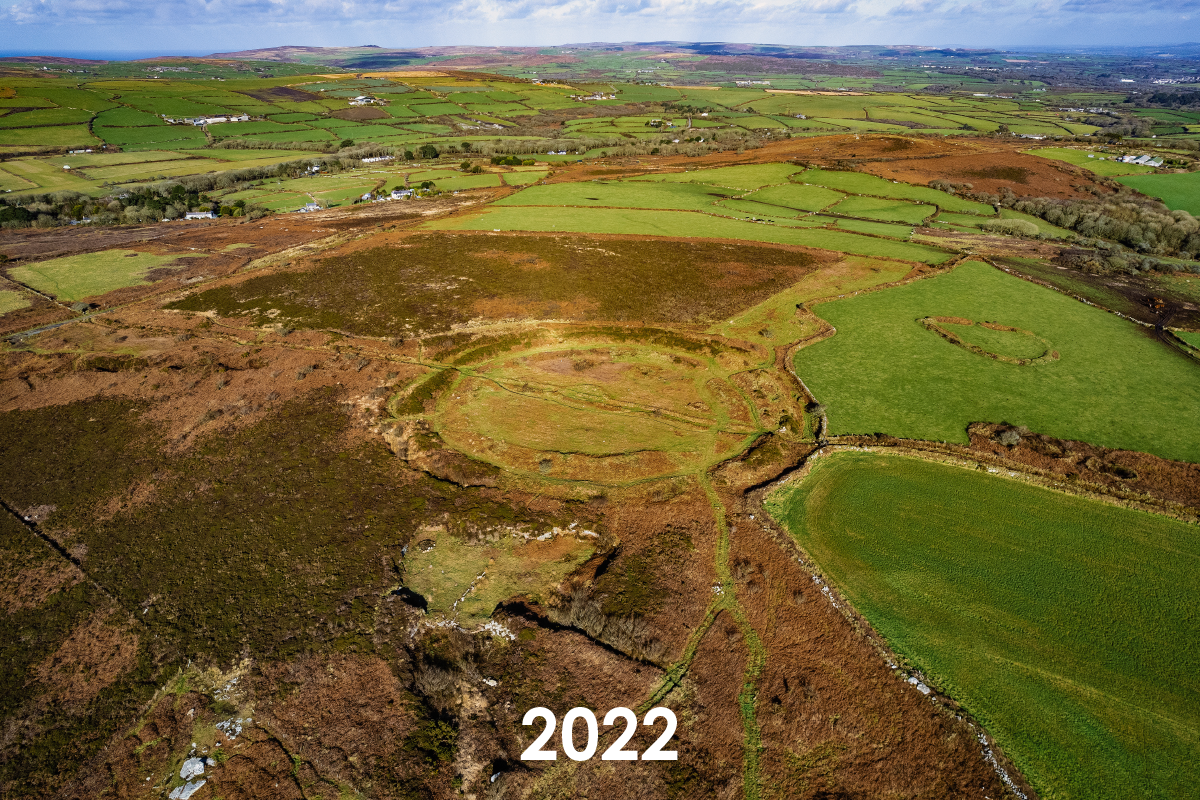
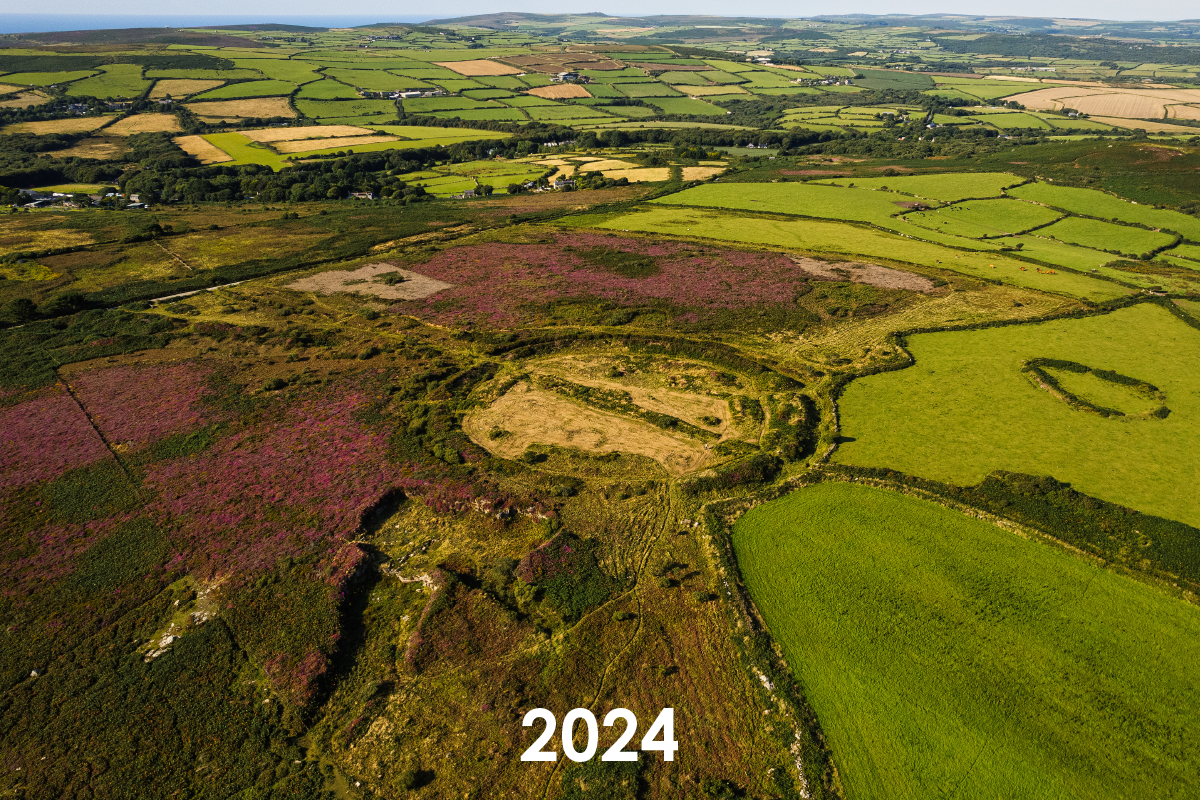
So many of Cornwall’s historic places desperately need protecting, and Caer Bran’s story is a testament to what can happen when they receive the care and land management expertise they need. The site’s rescue was made possible by the generosity and support of Miss Harry and Historic England and we’re immensely grateful!
Our members, supporters and donors are at the heart of making rescue missions like this possible. Should you wish to pledge a donation to our cause or become a member, we would be hugely grateful for your support. As a small, independent charity every penny makes a massive difference and ensures that places like Caer Bran can continue to be rescued for everyone to enjoy.
Our 39th AGM is taking place in the auditorium at the FibreHub in Pool on Monday 11th November from 12noon.
Open to all members, the AGM is a fantastic opportunity to find out about the exciting work which has taken place over the last year at the Trust. Members are being sent correspondence by either email or post formally inviting them to the AGM.
Date: Monday 11th November
Time: 12noon – 1pm
Address: FibreHub, Trevenson Lane, Pool, Redruth, TR15 3GF
The meeting will take place in person, however, we will also be offering the option of joining by Zoom, if preferred. If you would like to join us through Zoom, please contact the office at info@cornwallheritagetrust.org or call 01209 707008.
Agenda and Draft Minutes from AGM
A copy of the agenda for the AGM is available to download below along with the draft minutes of last year’s AGM. If you are unable to access the documents, please let us know and we will send you a paper copy in the post. Copies of our annual accounts can be requested and will be available from the AGM onwards.
CHT Draft AGM Minutes 16.11.2023
If you have any queries relating to the agenda or wish to propose a matter for discussion please do get in touch by email at info@cornwallheritagetrust.org.
The discovery of skeletal remains of a male in 2022 near Newtrain Bay, Trevone has been a cause for great excitement in the world of Cornish archaeology.
Richard Mikulski, a senior osteoarchaeologist at Cornwall Archaeological Unit, came to speak at our latest Story Cafe earlier this month about what they have learnt from this individual’s remains and potential future archaeological research into coastal remains and shipwrecks.

It was a fascinating talk using isotope and visual analyses as well as geographical data to place the bones in the story of Cornwall and bring the individual to life.
Radiocarbon dating indicates the remains most likely date from the 18th century, and analysis of the bones and distinctive wear on his teeth, believed to have been caused by biting rope, give strong evidence to suggest he was a sailor. This provides a possible story of who he was and how he ended up on the cliffs at Newtrain Bay.
If you couldn’t make it or want to watch it again, a full recording of the talk is available to watch here.
Please note that due to the nature of this subject matter, this talk includes a significant number of images of human remains.
The talk was delivered to a packed room of attendees, saffron buns in hand and was greatly enjoyed with a further question time allowing for deeper exploration of the subject. Thank you to Richard for his detailed and engaging talk!

The remains will be reinterred in Padstow Cemetery in Spring 2025. The proceeds from the talk will go towards a memorial headstone for the grave, which will be used to reinter the remains of storm-washed individuals discovered within the parish in the future. Any additional funds raised will go to Padstow RNLI. Thank you to everyone who attended for your generous support of these fundraising efforts!