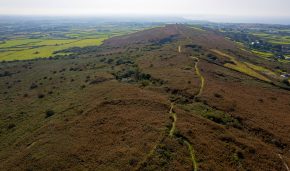
Castle an Dinas (West) is a small multivallate hillfort situated at the summit of a broad hill on Tonkins Downs, with extensive views of Mounts Bay. Hillforts of this kind are rare, with around 100 examples recorded across the UK.
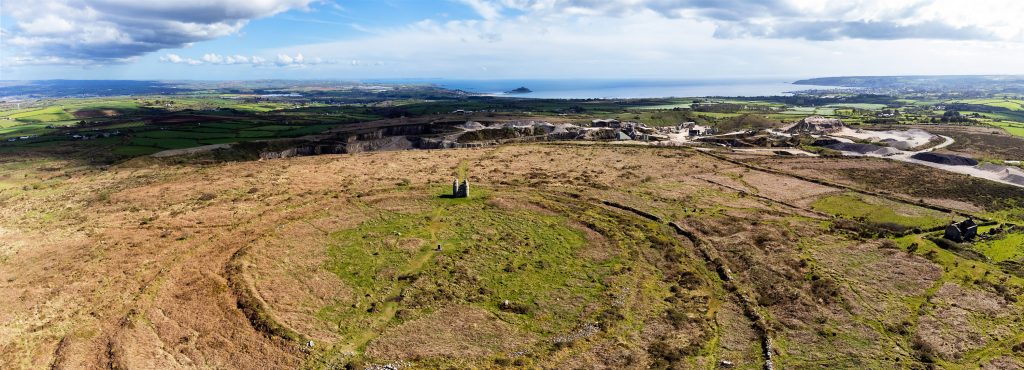
Photo credit – Julian Perry
Standing prominently on the hillfort’s inner rampart is Rogers’ Tower, a late 18th-century folly built for the Rogers family who owned nearby Treassowe Manor. The tower is a listed building Grade II.
In the heathland to the north of the hillfort are the remains of extensive prehistoric and medieval field systems. To the south-west, the small fields of a 19th-century smallholding have utilised the ramparts of the hillfort as part of their field system. Both folly and farmstead are important features in the landscape in this part of Cornwall.
The site lies within Cornwall National Landscape and includes a scheduled area which centres around the hillfort. It is designated as a Site of Special Scientific Interest and Country Wildlife Area, as well as being common land.
It is a mix of heathland and high pasture, which is rich in ecological value. Falcons, kestrels and many other interesting species are often seen when visiting the land. An ecological assessment is forthcoming in late spring 2026.
The land has a herd of Ruby Red cows grazing on it in the summer months. We have been reassured that they are docile and used to the public and dog walkers.
Ancient beginnings
Castle an Dinas survives as an almost circular enclosed area, which is defined by four concentric, widely spaced ramparts and a partially-buried outer ditch. Small multilvallate hillforts such as this date to the Iron Age period, most having been constructed and occupied between the 6th century BCE and the mid-1st century CE.

Photo credit – 3deep Media
The complexity of the ramparts and the existence of a small enclosure “without an entrance” at the centre of the fort hint at an early prehistoric origin. This inner circuit may be another example of an earlier hilltop ceremonial enclosure, comparable to those at Bartinney and Godolphin Hills.
The monument likely has a relationship to the local village of Chysauster and Little Chysuaster, which are on the hillside sloping away from the hillfort.
First recorded by Norden in the late 16th century as “a vaste and craggie rock” because of its size and prominence, the hillfort was noted on maps of Cornwall from around 1600 onwards. Finds of stone weights, stone vessels, swords, and a large gold ring were reported at the site by Polsue in the late 1800s.
A grand prospect
The exact date of the construction of Rogers’ Tower is unknown, but it was most likely built in the late 18th century for John Rogers (1750–1832). He was the only member of the Rogers family with both the wealth and opportunity to commission such a structure.

Rogers’ Tower in the late 19th century. The photographer, Alexander Gibson, can be seen sitting to the right of the building. © Penlee House Gallery & Museum, Penzance / Gibson Archive
John Rogers inherited his estate – including nearby Treassowe Manor – unexpectedly at the age of 22, became a barrister, and later held several important positions, including Mayor of Helston, MP for West Looe and Penryn, and Deputy Lieutenant of Cornwall. During his lifetime, he also developed the house, gardens, and parkland at Penrose near Helston.
The tower was both practical and symbolic. It enhanced the surrounding landscape, provided a destination for carriage drives and picnics, and acted as a visible statement of landownership and status.
From 1793, Britain was at war with France, and the threat of invasion was real. With its commanding views over Mounts Bay, Rogers’ Tower may have also served as a lookout point during this unsettled period.
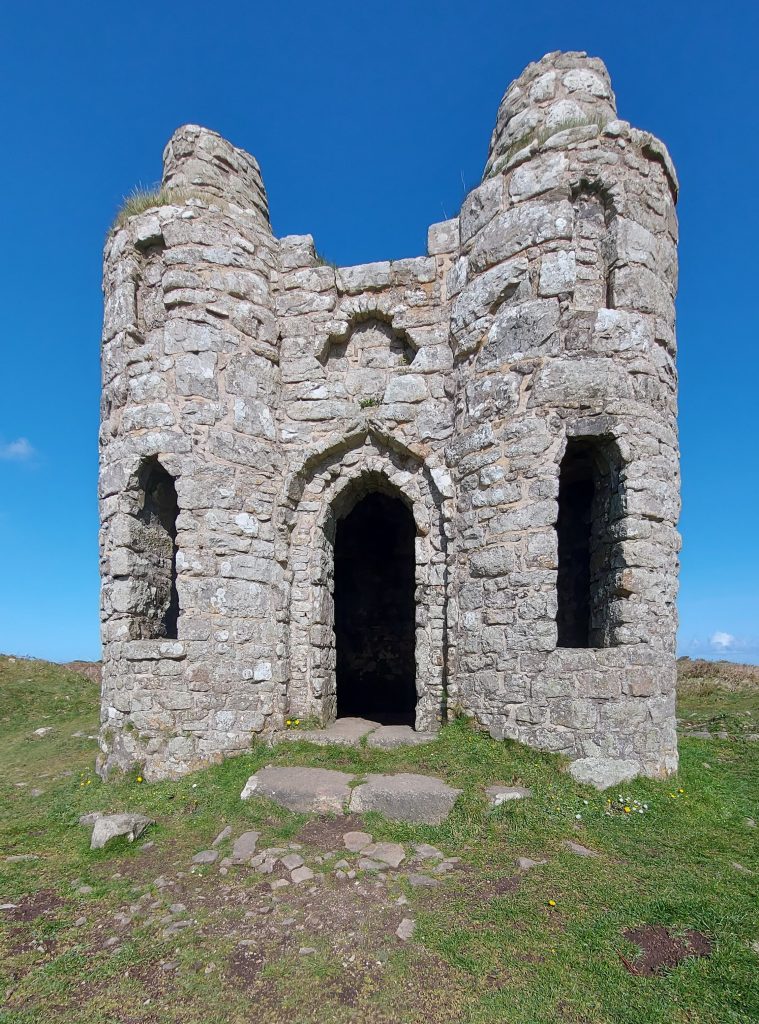
Rogers’ Tower as it stands today. Photo credit – Cornwall Heritage Trust
A working landscape
Around 1793, James Hosking moved to Treassowe. Unlike the Rogers family, whose interests lay in landscape and status, Hosking was a practical and independent farmer whose aim was to improve land for agriculture. His ambitions were typical of the period.
In 1803, Hosking took on the tenancy of Castle Downs and began breaking up the heathland below Rogers Tower to create productive farmland. The land remained in the family’s tenancy into the 1830s, and James Hosking was buried in a small plot beside an old track leading to Castle an Dinas.
By the mid-19th century, this smallholding formed the centre of a modest farm of about 11 acres. Over time, the farmyard developed gradually, with additional granite outbuildings added in the late 19th and early 20th centuries. The house remained occupied until 1953, when the last residents left due to quarry blasting nearby.
The farmhouse and its surrounding fields are important because they survive largely unaltered, providing a rare and tangible example of an early 19th-century Cornish smallholding and a way of life that has now disappeared.
Wild stories
Castle an Dinas is well known in local legend as the place where “Wild Harris” met his death while out hunting. According to the tale, he was thrown from his horse after it was frightened by the ghost of a maiden, said to have crossed its path in the shape of a hare.
After his sudden death, Wild Harris’ spirit was believed to haunt the area around Gulval, terrifying local residents. The haunting was eventually ended when a parson laid the ghost by setting him an impossible task: to count every blade of grass at Castle an Dinas nine times, keeping the restless spirit occupied for years to come.
Warning fires
The monument was an important site for beacon lighting, forming part of a wider network of hilltop beacons used to warn of danger. From Medieval times through to the Early Modern period, beacons were lit on prominent hills to signal the approach of enemy ships or invasion.
These beacon fires were most famously used during times of national threat, such as the Spanish Armada in 1588 and later periods of war with France. The commanding height and open views of Castle an Dinas made it an ideal location for such a warning system, linking local communities to the wider defence of the realm.