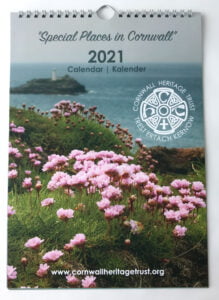
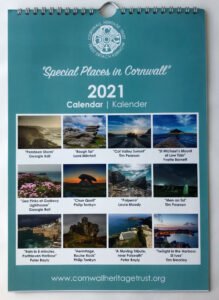
Introducing the Cornwall Heritage Trust Calendar for 2021, starring the winners from our 2020 Photography Competition: “Special Places in Cornwall”.
In August our Trustees had the unenviable task of selecting the top 12 photographs from over 100 competition entries, all of which were of a very impressive standard. The overall winner was then chosen by a public vote via our social media channels. Georgie Ball’s photograph entitled “Sea Pinks at Godrevy Lighthouse” was picked as the winning image. Georgie’s photo became the image on the front cover of the calendar and she also won £50.00.
You can purchase the calendar on our online shop here.
Month by Month Calendar 2021
The twelve winning finalists were:
January : “Pendeen Storm” by Georgie Ball
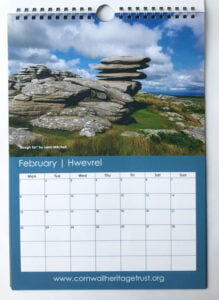
February: “Rough Tor” by Lemi Mitchell
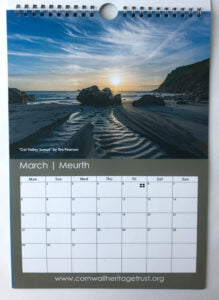
March: “Cot Valley Sunset” by Tim Pearson
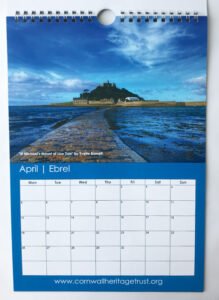
April: “St Michael’s Mount at Low Tide” by Yvette Barnett
May: “Sea Pinks at Godrevy Lighthouse” by Georgie Ball First Prize winner and the Front Cover.
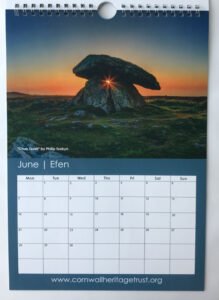
June: “Chun Quoit” by Philip Tonkyn
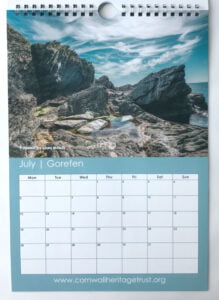
July: “Polperro” by Laura Moody
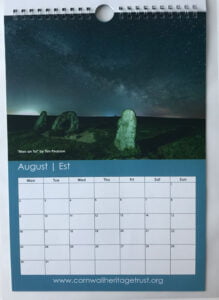
August: “Men an Tol” by Tim Pearson
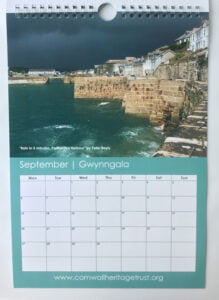
September: “Rain in 5 minutes, Porthleven Harbour” by Peter Bayly
October: “Hermitage, Roche Rock” by Philip Tonkyn
November: “A Moving Tribute, near Polzeath” Peter Bayly
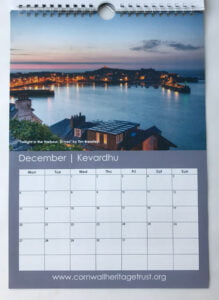
December: Twilight in the Harbour, St Ives” by Tim Brearley
Calendar details
The Cornwall Heritage Trust 2021 calendar is also a handy planning tool, with enough space to write those important dates and notes.
It is A4 size, with spiral binding and loop at the top so that you can hook it in a handy spot in your office or kitchen.
This calendar would make the perfect Christmas present for anyone who loves Cornwall and its rich heritage and landscape.
All the proceeds from the sales of our calendar will support the work of Cornwall Heritage Trust to preserve and strengthen Cornwall’s unique heritage.
£5.00 plus £1.50 Postage and Packaging.




Thanks to a grant from the National Lottery Heritage Fund we are seeking a talented filmmaker or videographer to help us produce short films of three of our historic sites for use on our website.
The films will be aimed at schools and each film will focus on an individual site. It is intended that they will be approximately two minutes each in duration and will feature a voiceover to describe each site, its specific areas of interest and its history. We anticipate that the films will include drone footage of each site to highlight their special features and to provide context.
If you are interested in finding out more about this exciting project please click on the link below to access the brief for more information and details about how to apply.

Useful Links:
Calendar 2021 “Special Places in Cornwall” Photography Competition. Voting for the Front Cover and First Place.
If you are viewing this page on a phone or tablet, you might find it easier to complete the form here
The Cornish National Music Archive (www.cornishnationalmusicarchive.co.uk) has recently been launched.
It is an online resource about music in Cornwall, featuring all kinds of music – from brass bands to choirs, pub songs to rock bands, and orchestral to pop.
Funded by the Cornwall Heritage Trust, Gorsedh Kernow and the Federation of Old Cornwall Societies, the collaborative project is the work of Cornish musicians and researchers Tony Mansell, Merv Davey, Kate Neale and Garry Tregidga, who have made the website during lockdown.
The project stems from an archive of sheet music and old manuscripts collected by the former Cornish Music Guild, which had been housed in the Cornish Studies Library until it was rediscovered by the group and handed to Kresen Kernow.
Merv Davey, director of Lowender Peran, said “Rediscovering the Guild’s archive was the spark that got us thinking that there ought to be somewhere that brings all types of Cornish music – and music in Cornwall – together.’
The website is freely available online for people to search and explore, and also has a section where visitors can create a profile and log in to write their own articles for publication. The creators encourage contributions on all aspects of music in Cornwall – with categories for individuals, performing groups, songs, tunes, and many more.
What qualifies for inclusion in an archive of Cornish music? Tony Mansell, projects co-ordinator, explained ‘We’ve put our heads together and decided that the archive should be broad and diverse, rather than narrow and prescriptive. It includes music that is, or has been, popular in and special to Cornwall, impactful in Cornwall, written in Cornwall, written about Cornwall, inspired by Cornwall – covering individuals, traditions and compositions that express, reflect and celebrate Cornwall and our distinctive identity.’ He continued “For example, my specialism is brass bands, so many of my articles focus the history of these hugely important groups for communities across Cornwall.’
Kate Neale, project lead, said “We’re hopeful that people will not only enjoy exploring what’s already there, but also contribute their own entries. You could add a biography of a composer you’ve a particular interest in, write up a memory about the best gigs you’ve seen in a particular venue in Cornwall – or give an account of a musical experience, whether as an audience member or as a performer – or something else. Really, we’re hoping that the archive will be a resource for music lovers of every type, spark ideas and discussions, and record important information for posterity’.
Garry Tregidga, co-director of the Institute for Cornish Studies at the University of Exeter, added ‘This is a wonderful opportunity to build on the fantastic work of the former Cornish Music Guild, and we hope that the archive will be useful for both amateur and professional researchers who are interested in Cornwall’s rich and diverse musical culture.’
The website is available at www.cornishnationalmusicarchive.co.uk and its data will eventually be handed to Kresen Kernow for safekeeping.
Cornwall Heritage Trust is currently considering grants for small applications of up to £500. To find out more, please visit our Grants page for details and the online application form.
Every year Cornwall Heritage Trust awards bursaries to post-graduate students at the Institute of Cornish Studies to assist in study costs for one or more students producing a dissertation/thesis centred on any aspect of Cornwall’s Heritage.
Kensa Broadhurst is currently studying for her PhD and sent us an update on her work and how she is managing to continue her research during Lockdown. Kensa hopes that not only will the research she carries out help our understanding of the use of Cornish during the nineteenth century and give more legitimacy and status to the language today, but also give the Cornish language a status within higher education.
 “My name is Kensa Broadhurst, and with funding from the Cornwall Heritage Trust I am studying for a PhD at the Institute of Cornish Studies, part of the University of Exeter based at its Penryn Campus. Through my research I am hoping to find evidence that the Cornish language was being used between 1777-1904.
The common perception is that Dolly Pentreath, a fish-seller from Mousehole, was the last speaker of Cornish and when she died in 1777, the language died with her. During the nineteenth century, several antiquarians did publish texts about the language, culminating in the publication in 1904 of Henry Jenner’s ‘Handbook of the Cornish Language’ which sparked the revival of Cornish as a community language which continues to this day. I am researching use of the language between these dates in Cornwall, by Cornish people. The Victorian gentlemen antiquarians mainly re-wrote previous research on the language, and don’t seem to have made much of an effort to engage with the common people of Cornwall who could well have still been using the language, so it is their stories, lives and possible use of Cornish I am searching for. Fortunately, in Cornwall we are blessed with several useful archives and libraries, including the Kresen Kernow (Cornwall Centre) which houses the former County Records Office and Cornish Studies Library, as well as the Morrab Library and the Royal Institution of Cornwall library.
I started learning Cornish about four years ago, initially as an academic exercise! Although I have a Cornish name, one side of my family is Cornish, and I had lived here on and off for about fifteen years, I really didn’t know very much about the language. My undergraduate degree was in French and Italian, and I had spent many of the intervening years as a languages teacher and examiner, but I quickly discovered Cornish is nothing like the languages we study at school! It is one of the five traditional Celtic languages of the British Isles along with Welsh, Gaelic, Irish and Manx, but is most closely related to Breton. Although there are some similarities to the languages I was familiar with in terms of grammar, much of the sentence structure is completely different, and so is the vocabulary.
Over the past four years I worked my way through the Cornish exam syllabus and in the summer of 2019, passed my final exams in language, medieval and modern literature, history of the language and Cornish place names. I now teach an evening class to beginners, tutor for an online Cornish course, set exams for the exam board and contribute to the training of my fellow Cornish teachers. I also write and read the weekly news bulletin in Cornish on BBC Radio Cornwall as part of a small team! Our bulletin is broadcast on Sunday afternoons.
Obviously the past few months have resulted in a change of approach for me, as for everyone else. How do you do research, when you can’t physically access the things you need? You find other things to do. I guess I’m far luckier than my peers who are researching in a scientific discipline, in that I don’t have to physically be in a lab, experimenting and measuring things to get results (can you tell I’m not a scientist?!). In an ideal world I would be sat in Kresen Kernow, or the Morrab library in Penzance, or the Courtney Library in Truro, methodically going through newspapers or documents looking for evidence of people using Cornish.
One thing I’ve learned very quickly over the past eight months since I started my PhD is that it’s not just about the research. It’s about creating opportunities to connect with people and creating opportunities to get your research and your topic “out there.” Some of the extra online training opportunities the Exeter University Doctoral College have been putting on for us over the past couple of months have included using various social media platforms to advertise and inform people about our research – such as blogs, Twitter and podcasts. I was even lucky enough to sit on a panel discussing the merits and use of blogging. Last week we had the first virtual meeting of a Community-based Journal organised by a doctoral student in the Medical School, which gives us an opportunity to both hear what other people are researching and talk about our own work.
I have been keeping busy. I have just submitted a chapter of my thesis for my upgrade examination and have a viva to look forward in the next few weeks to discuss both the chapter, and my plans for my research over the remainder of my studies. I’ve also submitted an article for publication in a journal (in Cornish) and need to start thinking about a conference in the Autumn and what I might be able to speak about. Now it’s back to reading what I can access (what did we do before the internet? I mainly remember the library at my undergraduate university only allowing us to loan a book for 24 hours at a time) and writing the looming second chapter.”
Find out more about Cornwall Heritage Trust bursaries.
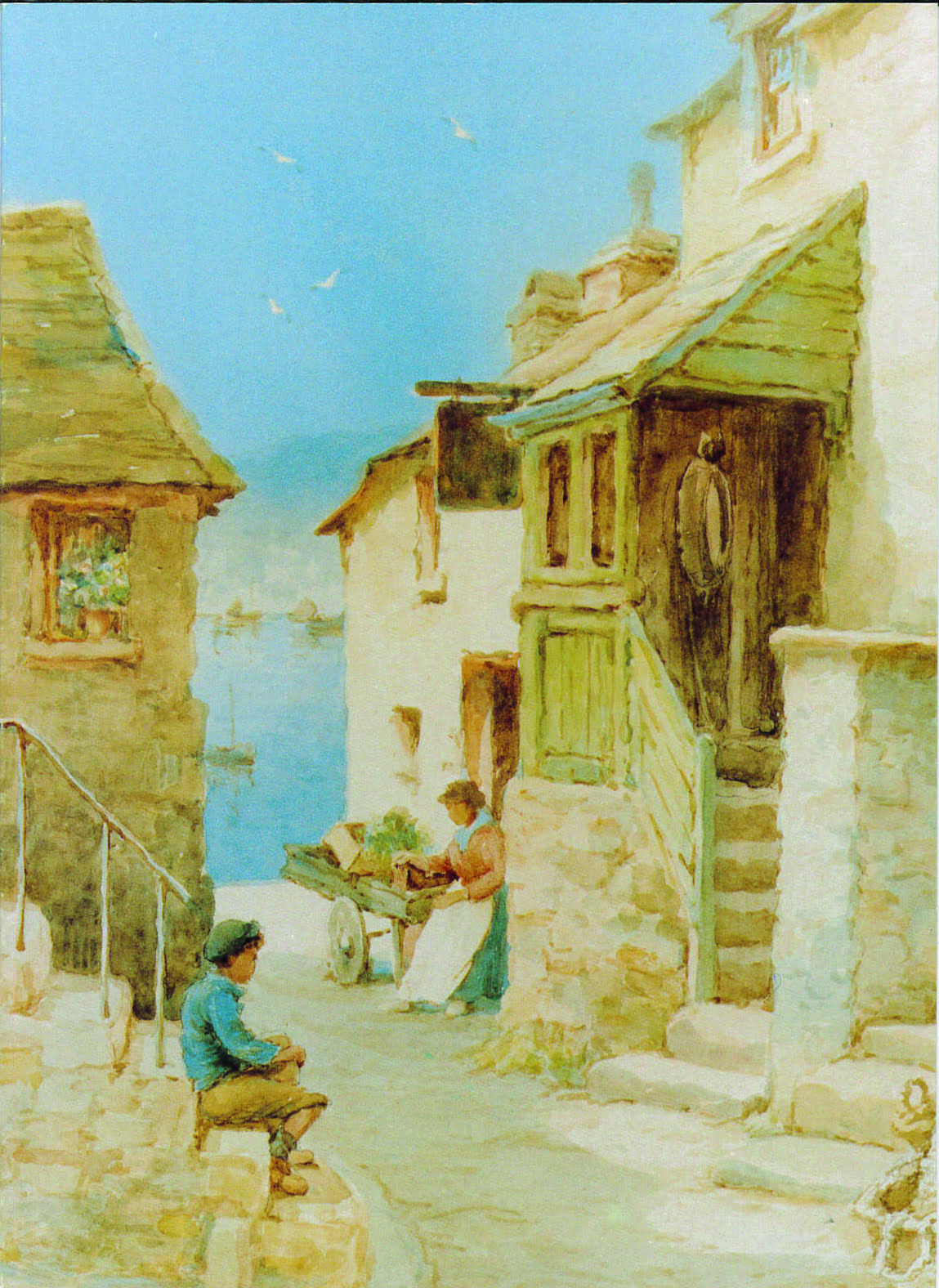
“Figures and Handcart” by Lamorna Birch.
One of the Lamorna Birch paintings in the Paul Smales Collection bequeathed to Cornwall Heritage Trust.
Calendar 2021 – Photo Competition – “Special Places in Cornwall”
We’re looking for photos for our 2021 Calendar. If you have photos of new places you’ve discovered close to home during your lockdown walks or of your special places in Cornwall you were pleased to get back to when lockdown was eased we would love you to send them in to us.
To enter, please email your photograph to info@cornwallheritagetrust.org and provide the following information:
- Name of person who took the photograph
- Email address
- Age of person who took the photograph
- Title of Image
- Location of where the photo was taken in Cornwall
- Date the photo was taken
12 winners will be chosen with each winning photo published in the Cornwall Heritage Trust 2021 Calendar with their name. Each winner will receive a free calendar.
In addition to the calendar there will be prizes for the top 3 winners:
1st Prize – £50
2nd Prize – £30
3rd Prize – £CHT Family Membership (worth £25)
For more details on how to enter and the Competition terms & conditions please visit –

Following the latest advice from the Government regarding the outbreak of Cornonavirus we have reviewed our working practises and most of our staff will now be working from home. We are in the fortunate position that we are able to complete the vast majority of our usual work remotely and this will not impact on business as usual.
The wellbeing of our staff and trustees is paramount in this decision, as well as the safety of our neighbours and the general public at Krowji.
We do not foresee any issues relating to our temporary closure of the office; if you need to contact us please do so in the usual way by emailing info@cornwallheritagetrust.org or call us on 01209 707008.
We hope that everyone manages to stay well and look forward to being back to normal as soon as possible!
We are delighted to announce that we are now accepting applications for grants ahead of our first deadline, which will be 1st of May 2020, for consideration at our Trustees meeting in June. Our grants are aimed at Cornish community groups, charities and not for profit organisations working on projects with outcomes which preserve and strengthen Cornwall’s unique heritage and meet our organisational objectives.
For more information on our grants scheme, or to apply for a grant, please refer to our Grants page
Delayed slightly by the very wet weather leading to an overflow into the aqueduct, the investigatory works at Treffry Viaduct have now commenced.

The tramway has been opened up in two places along the length of the viaduct, with three granite sleepers lifted in each section; work is now starting on a third location. The sleepers are enormous with one weighing in excess of two tonnes! The work is undoubtedly hindered by the recent wet weather and the aqueduct channel is currently holding water in the places where the silt has been removed. The silt was between 300-400mm thick and has to be removed in order to access the bedstones, pumps are also being used to remove the standing water.

Interestingly, the bedstones at the North West end have been lifted previously and work undertaken to lay cement in the joints between the stones. The other two locations are considered to be fresh-lifted, however the middle site also seems to have had the joints cemented which came as a surprise. If the third location shows signs of the same work it may be assumed that work took place in the last 60 years to renovate the joints along the length of the channel. The channel itself is approximately 1.1 metre deep.
 The next step is to undertake core drilling on the NW end and investigate the structure beneath the bedstones further with the use of a borescope.
Access to the viaduct itself remains closed for the duration of the works however the footpaths throughout the valley are open as usual.
Last weekend Cornwall Heritage Trust took over the Royal Cornwall Museum in Truro for the day and held two events to “Celebrate Cornwall’s Heritage”.
During the day the Museum was free for visitors to come and explore and enjoy the additional activities organised by the Trust. Everyone enjoyed the opportunity to enter the Christmas card design competition, make their own badges, get their faces painted, listen to traditional Cornish stories, participate in a Manga drawing workshop with Keith Sparrow and paint pebbles with #BiliKernow. Families were encouraged to roam the Museum to search for pictures of Hairy Tej as part of a treasure hunt and Hairy Tej himself was also present!! The day’s entertainments ended with a wonderful performance from the Cornwall County Boys and Girls Choirs.


CHT Community Engagement Officer, Belinda Body commented “Over 650 people came to the event and took the opportunity to explore the fascinating exhibits and take part in some of the special activities. We leaflet-dropped the local Primary Schools and clearly the message got through! Thank you to everyone who came along and learned a little bit more about Cornwall’s unique heritage”
In the evening a reception was held for invited guests and hosted by the Trust’s President, Colonel Edward Bolitho. Tiffany Truscott from BBC Radio Cornwall compered the awards ceremony which started with the presentation of the Sir Richard Trant Memorial Award for Heritage Champion 2019. This year’s winner was Will Coleman for his work promoting Cornwall’s heritage through projects such as the Man Engine and Golden Tree Productions. A new Heritage Champion Award for Groups and Organisations was presented to the Cornish Wrestling Association, their representatives were delighted that their contribution to the preservation of Cornwall’s heritage was recognised.
The prize for the overall winner of the 2020 Calendar Photographic Competition was awarded to Tim Pearson, whose stunning photo is featured on the front cover of the calendar. Tim received a framed print of his winning image provided by Banana Shed Framing in Penryn.
Colonel Bolitho also formally launched the new “Heritage Friends” scheme, an opportunity for businesses and organisations to support the Trust’s work. More information about this new initiative can be found here.
Guests were treated to refreshments kindly provided by Colwith Farm Distillery and Navas Tonic and enjoyed superb performances by the Cornwall Youth Choir. They also took the opportunity to view two of the paintings bequeathed to Cornwall Heritage Trust by Paul Smales; watercolours by Lamorna Birch and Charles Napier Hemy were on display.
Cathy Woolcock, CHT CEO, commented: “The whole day was an outstanding success and really gave us the chance to promote Cornwall’s heritage and engage with many new faces. We are very grateful to everyone who helped to make the day a success. Special thanks to Colwith Farm Distillery and Navas tonics for the refreshments in the evening and Emma Griffin Photographer and Banana Shed Framing for the photography prize. A big thank you to Tiffany Truscott for compering the awards ceremony and to James and Nicky from the Royal Cornwall Museum for their support and patience! Finally, thank you to everyone who came along and made the day such a success!”
Weather permitting it is planned to undertake investigatory works at Treffry Viaduct, starting this week. For public safety the viaduct will therefore be closed for a period of 5 weeks from Wednesday 6th November 2019.
If you are planning to visit Luxulyan Valley all of the footpaths and walks will be open, with the exception of the tramway running across the top of the viaduct.
The works aim to give us more information on the structure and therefore inform any plans for future projects, it is vital that these investigations are carried out and we apologise for any inconvenience caused.
If you have any questions relating to this matter please feel free to contact the CHT office: info@cornwallheritagetrust.org
Click here to find out more about Treffry Viaduct and Luxulyan Valley
We are thrilled to announce that Historic England has removed Trethevy Quoit from the Heritage At Risk Register.
Trethevy Quoit was placed on the Register in 2016 when the sale of the surrounding field looked likely to affect the setting of this important Scheduled Monument. With the help of a grant from Historic England, Cornwall Heritage Trust were able act quickly to purchase the field thereby saving the setting and accessibility to the Monument.
Having acquired the field a project was subsequently developed to make improvements to the site, which included replacing a Cornish hedge and updating the access gates and culminated with an archaeological dig at the site in July this year; the outcome of which was the discovery of a significant platform of greenstone. The project has seen increased interest in the site and the community day at the end of the dig was extremely well attended by people keen to learn more about the history of this fascinating place.
We are delighted that thanks to our intervention this important “portal dolmen”, believed to date back to 3500BC, is now deemed as “saved” and has been removed from the Heritage At Risk Register. Our grateful thanks to Historic England and English Heritage for their support.
-

- Volunteers at the Dig